Probabilistic Day-Ahead Power Forecasting in the Medium-Voltage Grid Using Structured State Space Models
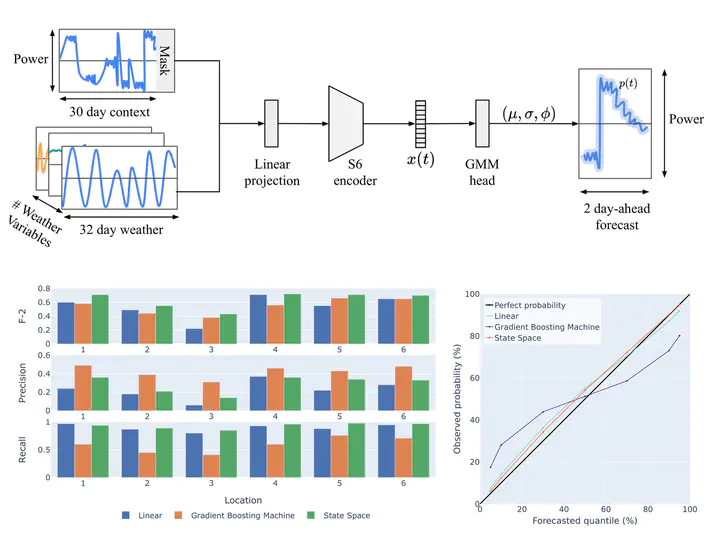 Top: model architecture — power and weather context passed through an S6 encoder and GMM head to produce a probabilistic 2 day-ahead forecast. Bottom left: F-2, precision and recall of 2-day ahead forecasts across the 6 test substations. Bottom right: calibration plot comparing forecasted quantiles with observed probabilities; the state space model closely tracks the perfect probability line.
Abstract
Short-term power forecasting is becoming more challenging due to the growing integration of renewable energy sources. This paper presents a novel application of structured state space models for probabilistic day-ahead power forecasting in the medium-voltage grid. These probabilistic outputs enable grid operators to make informed decisions with knowledge of prediction (un)certainties. The model receives both historical power measurements, historical weather measurements and weather forecasts to generate a power forecast. We validated our approach on a dataset comprising of 10 years of measurements from 312 substations across the Dutch electrical grid. Results showed that our approach achieves superior performance compared to traditional machine learning methods. Our findings suggest that structured state space models offer a promising direction for improving the accuracy of power forecasts and providing grid operators with reliable uncertainty quantification.

Jessica Loke
Research Scientist
My research interests include visual perception and cognition in humans and artificial neural networks networks.